
30 DevOps Interview Questions (and How to Think About Them)
Preparing for a DevOps interview in India? These are the questions that actually come up — across Linux, Git, Docker, Kubernetes, CI/CD, cloud, and scenarios — with guidance on strong answers.
Rajesh Vardhan Busam
DevOps Instructor & Mentor
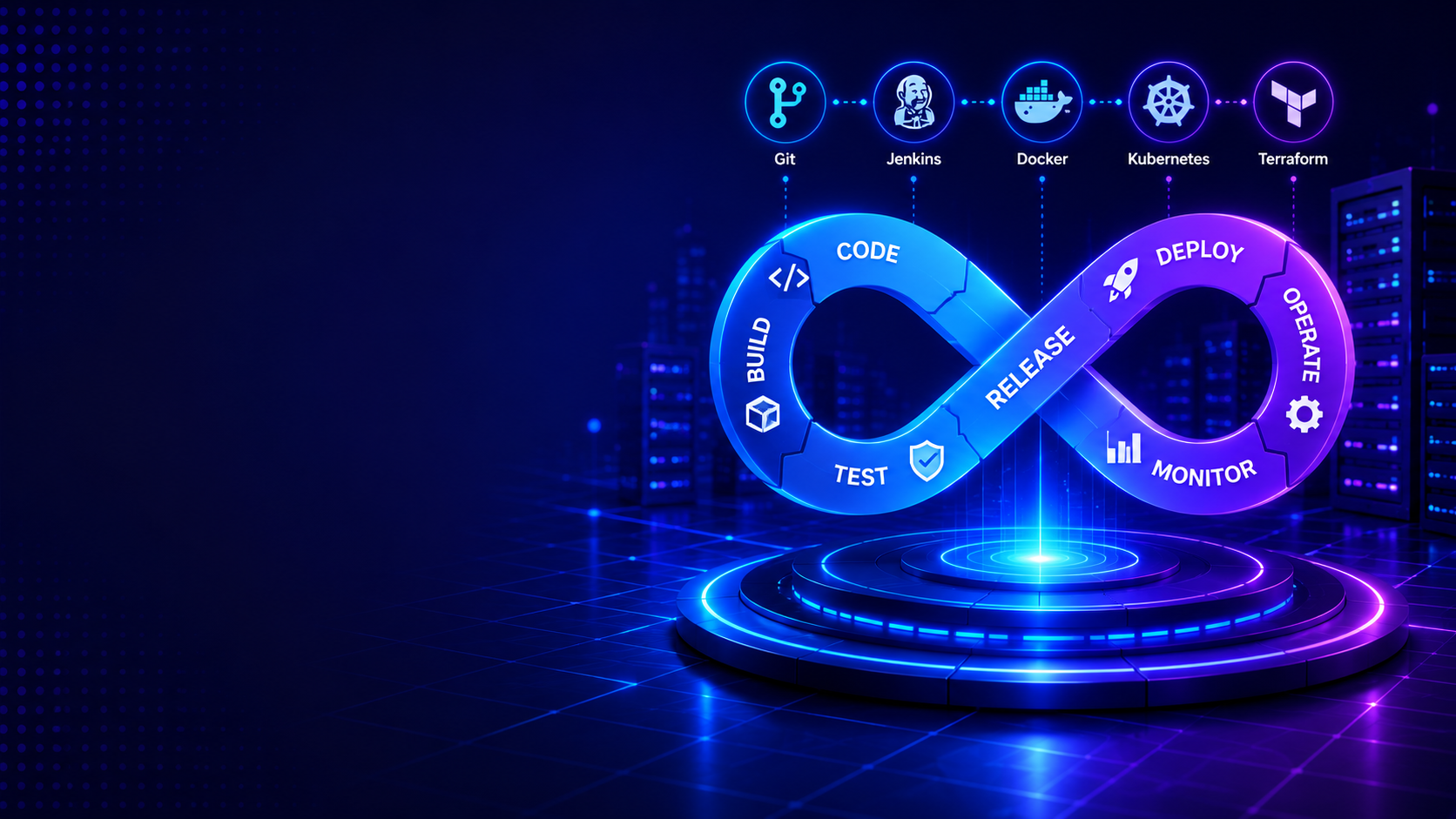
DevOps interviews in India mix fundamentals, tool depth, and real-world scenarios. Interviewers are less interested in textbook definitions and far more in whether you understand how things work and why you would make a given choice. This guide walks through the areas that consistently come up — with the kinds of questions asked and guidance on what a strong answer looks like — so you can prepare with focus rather than anxiety.
How DevOps Interviews Are Structured
A typical DevOps interview has three layers. First, fundamentals across Linux, Git, and networking. Second, depth in the core tools — Docker, Kubernetes, CI/CD, cloud, and infrastructure as code. Third, and most revealing, scenario and troubleshooting questions that test how you think under pressure. Strong candidates do well across all three, but it is the scenario layer that usually decides the outcome, because it cannot be memorised.
Linux and Scripting
Expect questions like: how do you find which process is using a particular port, how do you check disk and memory usage, how would you find the largest files on a full disk, and how do you view a live log stream and filter it for errors. The best answers give the exact commands and explain when you would reach for each. Be ready to write a simple shell script that automates a repetitive task, and to explain what it does line by line.
Git and Collaboration
Common questions include the difference between merge and rebase and when you would use each, how you resolve a merge conflict, what a branching strategy is and which you prefer, and how you would undo a commit that has already been pushed. The strongest answers connect the mechanics to team workflow — why a particular strategy reduces conflicts, and why you rebase your own feature branch but never a shared one.
Docker and Containers
You will be asked the difference between an image and a container, how to reduce image size, what a multi-stage build is, and the difference between a container and a virtual machine. Interviewers love to probe layer caching, because explaining how instruction order affects build speed signals genuine hands-on experience rather than surface knowledge.
Kubernetes
Expect the relationship between pods, deployments, and services; how a service discovers and load-balances across pods; what happens when a pod crashes and how the cluster recovers; the difference between a ConfigMap and a Secret; and how you would roll out a new version safely and roll it back if needed. Being able to describe how a request travels from an ingress through a service to a pod is a strong signal that you understand the system rather than just its commands.
CI/CD
Questions cover the difference between continuous integration, delivery, and deployment; what stages your pipeline has and why; how you handle secrets in a pipeline; and how you would design a pipeline that tests and deploys a containerised application. The best move here is to describe a pipeline you have actually built — concrete beats theoretical every single time, and it invites follow-up questions you are well prepared for.
Cloud and Infrastructure as Code
On AWS you might be asked the difference between a security group and a network ACL, public versus private subnets, how you would host a highly available web application, and how infrastructure as code with Terraform improves on clicking around a console. Tie your answers to reliability and cost, because that is how architects think and it shows maturity beyond just making something work.
Scenario and Troubleshooting Questions
These separate strong candidates from the rest, and they are the questions you cannot memorise. A classic is: a website is down, walk me through how you would investigate. A good answer is methodical rather than a lucky guess. You check monitoring and any recent deployments first, then work from the user inward — through the load balancer, the application, and the database — checking logs and resource usage at each layer, forming and testing hypotheses, and communicating your findings as you go. The interviewer is watching your reasoning process, not waiting for a single memorised answer. Staying calm and structured is itself part of the answer.
Behavioural and Culture Questions
DevOps is as much about collaboration as tools, so expect questions about a time you handled a production incident, how you work with developers, or how you approach learning a new technology. Prepare two or three concrete stories about real problems you solved, structured as the situation, what you did, and the result. Interviewers remember stories far more than abstract claims about your skills.
How to Prepare Effectively
- Build real projects and be able to explain every decision you made and every alternative you rejected.
- Practise explaining concepts out loud and simply — teaching a concept reveals the gaps in your own understanding.
- Keep a GitHub portfolio with working pipelines and infrastructure code that interviewers can actually look at.
- For each tool, know not just how to use it but why you would choose it over the alternatives.
- Rehearse the down-website troubleshooting scenario until your structured approach is second nature.
Common Mistakes
- Memorising definitions without being able to apply them to a scenario.
- Claiming experience with tools you have only watched videos about — follow-up questions expose this quickly.
- Freezing on troubleshooting questions instead of thinking out loud methodically.
- Having no concrete project to discuss, so every answer stays abstract.
Frequently Asked Questions
What matters most for a fresher DevOps interview? Solid fundamentals, one or two real projects you can discuss in depth, and a calm, structured approach to scenario questions.
Do I need certifications to get interviews? They help you get past automated filters, especially the AWS Solutions Architect Associate, but they do not replace hands-on experience in the interview itself.
How do I stand out? Speak from real experience, explain your reasoning, and show that you understand trade-offs rather than just tool commands.
Confidence in interviews comes from genuine hands-on experience, not memorisation. Every course at Infinity Cloud Labs is built around real labs and projects precisely so you can speak from experience — and our mentorship includes interview preparation and mock interviews, in both English and Telugu.
Tags