
The Complete DevOps Roadmap for 2025 — From Zero to Job-Ready
A step-by-step learning path covering Linux, Git, Docker, Kubernetes, CI/CD, Terraform, and monitoring — exactly what Indian DevOps engineers need to land their first role in 2025.
Rajesh Vardhan Busam
AWS Certified DevOps Engineer
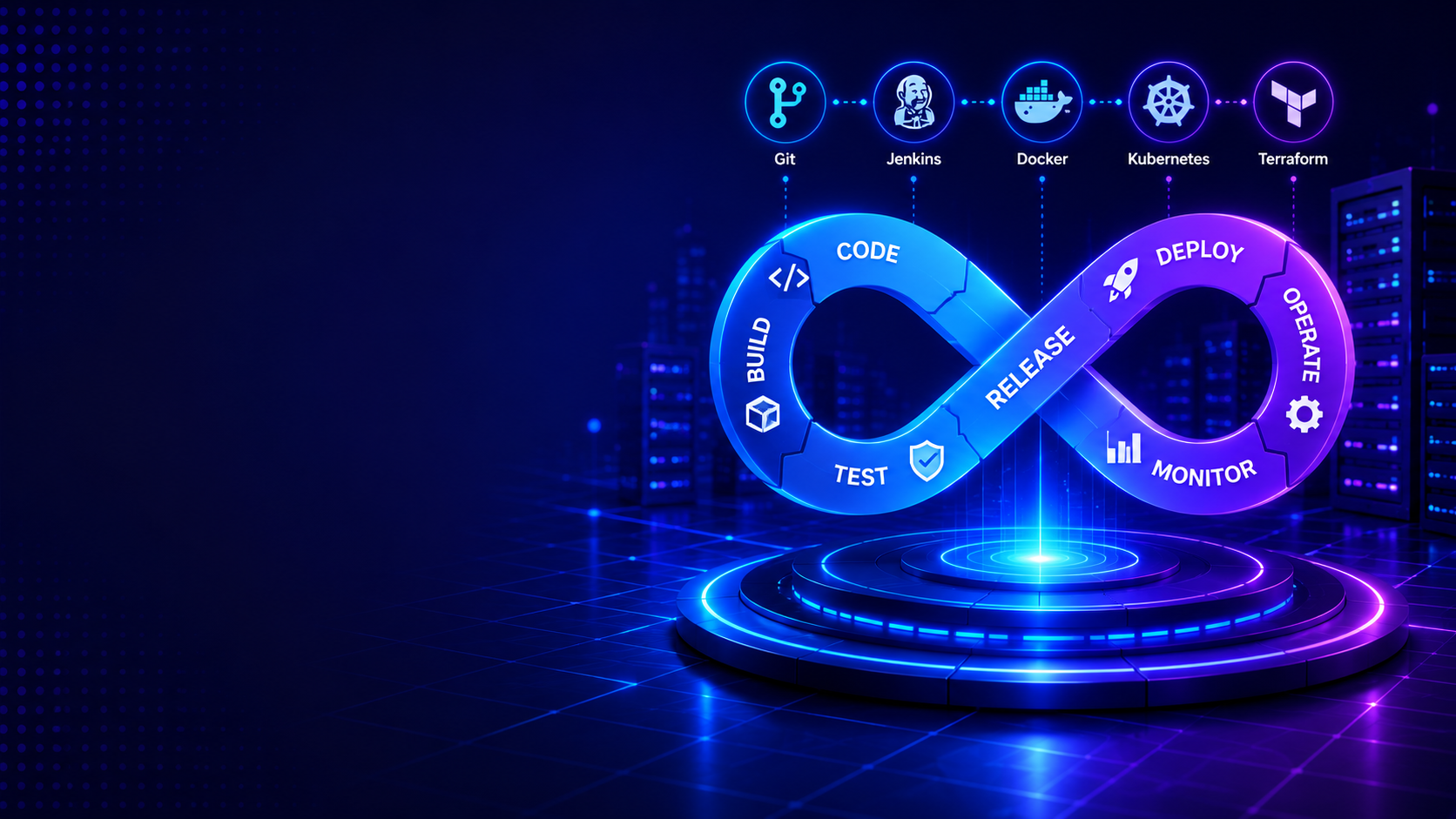
DevOps is one of the most in-demand and best-paid disciplines in Indian tech today. Companies across Hyderabad, Bengaluru, Pune, Chennai, and remote-first startups are hiring aggressively, with freshers starting around 6 to 10 lakh per annum and experienced cloud-DevOps engineers earning 25 to 45 lakh and beyond. But the field is broad, and without a clear plan it is easy to drift between random tutorials and never feel job-ready. This roadmap gives you a deliberate, ordered path based on what hiring managers actually test for in 2025.
How to Use This Roadmap
Treat this as a ten-month plan if you study part-time, or a four-to-five-month plan if you can dedicate full days. The order matters: each phase builds on the last. Resist the temptation to jump straight to Kubernetes or the cloud before you are comfortable with Linux and containers — every senior engineer will tell you the fundamentals are what separate people who can operate systems from people who only follow tutorials.
Phase 1: Foundations (Months 1 to 2)
Linux
Every server, container, and cloud instance runs Linux. Start with Ubuntu. Learn the file system layout, permissions, users and groups, processes, package management, systemd services, cron jobs, and shell scripting with bash. You should be able to write a script that, for example, rotates logs or backs up a directory. Practical test: provision a cloud VM and configure a web server entirely from the terminal without a graphical interface.
Networking
Many DevOps problems are networking problems in disguise. Understand the TCP/IP model, DNS resolution, HTTP and HTTPS, ports, load balancing, NAT, and firewalls. Learn to use curl, dig, ss, and traceroute to diagnose connectivity. When a service cannot reach a database, you must be able to reason from client to server about where the packet stops.
Git and Version Control
Git is non-negotiable and comes up in every interview. Master branching, merging versus rebasing, resolving conflicts, pull requests, and at least one branching strategy such as trunk-based development. Understand how teams collaborate and how code review works in practice.
Phase 2: Containerisation (Month 3)
Docker is the gateway to modern DevOps. Learn to write clean Dockerfiles, understand image layers and caching, use multi-stage builds to keep images small, and run multi-service applications locally with Docker Compose. Understand container networking and volumes. A minimal, security-aware Dockerfile looks like this:
FROM node:20-alpine
WORKDIR /app
COPY package*.json ./
RUN npm ci --omit=dev
COPY . .
USER node
EXPOSE 3000
CMD ["node", "server.js"]
Notice how dependency files are copied and installed before the source, so a code change does not invalidate the dependency cache — a single trick that turns a three-minute build into ten seconds.
Phase 3: Orchestration (Months 4 to 5)
Kubernetes is the single most in-demand DevOps skill in India. Start with the core objects: pods, deployments, and services. Then progress to ConfigMaps and Secrets for configuration, Ingress for external routing, persistent volumes for storage, namespaces for isolation, and RBAC for access control. Learn how a request travels from an ingress through a service to a pod, and what happens when a pod dies and the deployment recreates it. Finally, learn Helm to package applications so you can deploy the same chart to dev, staging, and production with different values.
Phase 4: CI/CD (Month 6)
Continuous Integration and Delivery is the heart of DevOps. Learn to build pipelines with GitHub Actions and Jenkins that check out code, run tests, build a container image, push it to a registry, and deploy automatically. Understand how secrets are injected securely, how to cache dependencies for speed, and how branch protection rules force every change through the pipeline before merging. Being able to describe a pipeline you built is one of the strongest things you can bring to an interview.
Phase 5: Cloud (Months 7 to 8)
AWS dominates the Indian market, so start there. Focus on EC2 for compute, S3 for storage, VPC for networking, IAM for access, RDS for managed databases, Lambda for serverless, and EKS for managed Kubernetes. Understand availability zones and how to design for high availability. Earning the AWS Certified Solutions Architect Associate certification meaningfully improves your callback rate — many job filters explicitly look for it.
Phase 6: Infrastructure as Code (Month 9)
Clicking around a console does not scale and is not repeatable. Terraform is the industry standard for provisioning cloud infrastructure declaratively. Learn HCL syntax, resources, variables, outputs, modules, remote state, and workspaces. Pair it with Ansible for configuring the servers once they exist. Together, Terraform builds the machines and Ansible sets them up.
Phase 7: Observability (Month 10)
Production systems must be observable. Learn Prometheus for metrics, Grafana for dashboards, and a log aggregation tool such as Loki or the ELK stack. Understand the four golden signals — latency, traffic, errors, and saturation — and how to write actionable alerts that page a human only when users are actually affected.
Build Real Projects
Knowledge without a portfolio rarely gets hired. Build and document at least three end-to-end projects on GitHub, such as:
- A three-tier web application on AWS provisioned entirely with Terraform, deployed through a GitHub Actions pipeline, running on EKS, with Prometheus and Grafana monitoring.
- A CI/CD pipeline that builds, scans, tests, and deploys a containerised app on every push.
- A monitoring and alerting stack that detects and reports a simulated outage.
Employers want engineers who can do, not just study. A clear README explaining your architecture decisions is worth more than any certificate on its own.
Salary Expectations in India (2025)
- 0 to 1 year: 6 to 10 LPA
- 2 to 4 years: 12 to 22 LPA
- 5 or more years with cloud expertise: 25 to 45 LPA
- Specialised SRE, Platform, and AI-Native DevOps roles: often higher still
Common Mistakes to Avoid
- Skipping Linux and Git to rush into Kubernetes — you will constantly hit walls you cannot debug.
- Collecting certificates without building anything real.
- Learning tools in isolation instead of connecting them into a working pipeline.
- Never touching production-like scenarios, so troubleshooting questions in interviews catch you off guard.
Frequently Asked Questions
Do I need to be a strong programmer? You need scripting comfort (bash and a bit of Python), not full software-engineering depth. The ability to automate is what matters.
Which cloud should I learn first? AWS, because it has the largest market share and the most job openings in India. You can add Azure or GCP later.
How long until I am job-ready? With consistent daily effort, most learners reach an entry-level DevOps interview level in six to ten months following this roadmap.
At Infinity Cloud Labs, our DevOps track is built around exactly this progression, with hands-on labs and real projects on infrastructure you control, taught in both English and Telugu — so you learn by doing, not just watching.
Tags