Top 10 DevSecOps Tools Every Security Engineer Should Know in 2025
A practical overview of the essential DevSecOps tools — SonarQube, Trivy, OWASP ZAP, Snyk, Checkov, and more — with use cases and CI/CD integration tips.
Rajesh Vardhan Busam
DevSecOps Engineer & Security Automation Specialist
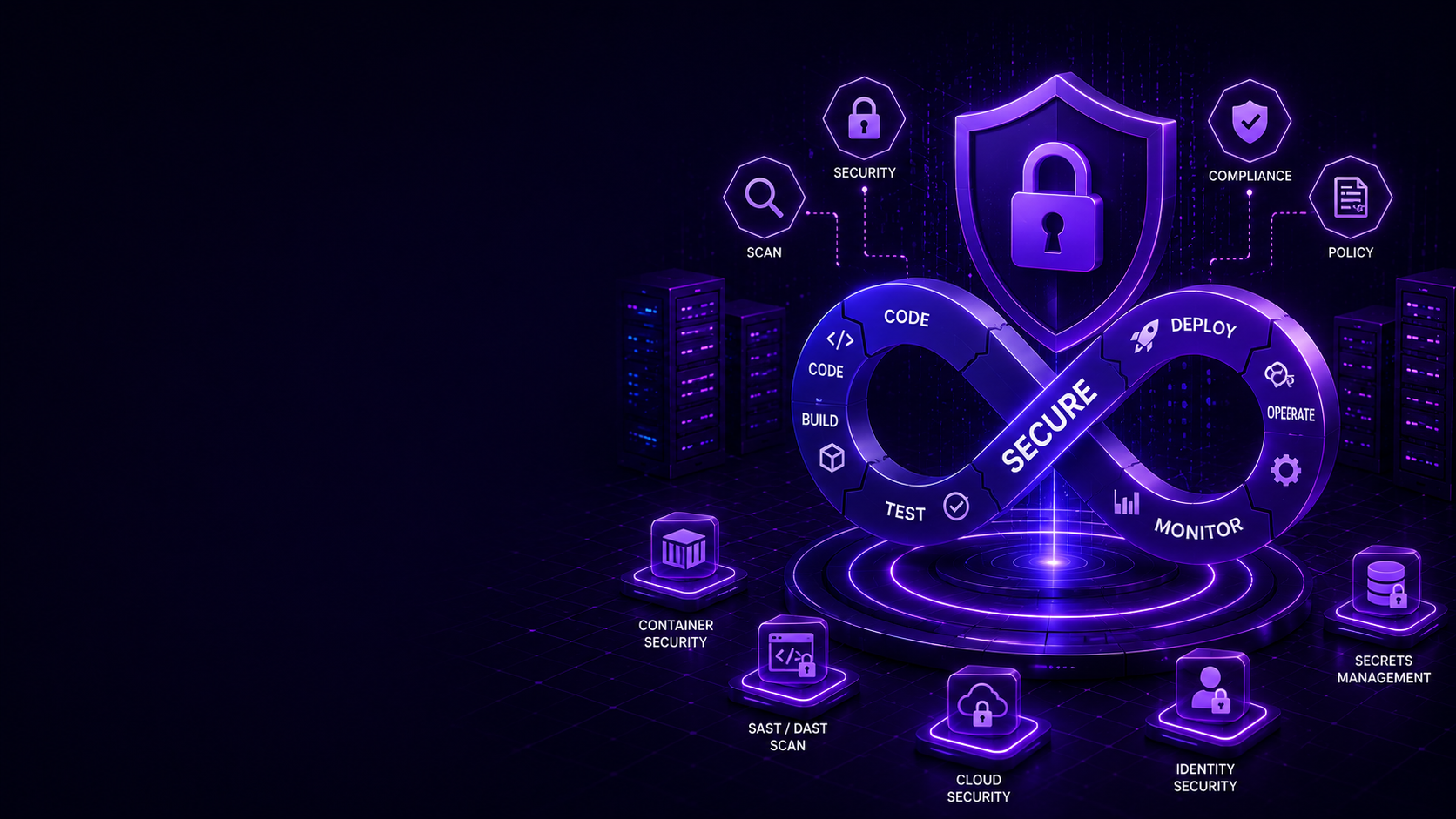
Security used to be a final gate — a team that reviewed software just before release and often blocked it. That model is too slow for modern delivery. DevSecOps replaces it by shifting security left: building security checks into every stage of the pipeline so problems are caught early, automatically, and cheaply. To practise DevSecOps you need to know the tools that make it possible. Here are the ones that matter, organised by where they fit in the software lifecycle, along with what each actually does.
The DevSecOps Philosophy
The core idea is simple: security is everyone's responsibility and it happens continuously, not once at the end. Every code commit, dependency, container image, and infrastructure change is automatically scanned. When a vulnerability appears, the pipeline flags it immediately — while the developer still has the context to fix it. This is far cheaper than discovering the same flaw in production. The tools below automate that continuous checking.
1. Static Application Security Testing (SAST)
SAST tools analyse your source code without running it, looking for insecure patterns such as SQL injection risks, hardcoded secrets, and unsafe functions. Because they run early — often on every pull request — they catch problems before code ever ships. SonarQube is a widely-used option that also measures code quality, and Semgrep offers fast, customisable rules. Run SAST in your CI pipeline and fail the build on high-severity findings.
2. Software Composition Analysis (SCA)
Modern applications are mostly third-party dependencies, and vulnerabilities in those libraries are one of the most common attack vectors. SCA tools scan your dependency tree against databases of known vulnerabilities and tell you which packages to upgrade. Trivy is an excellent, fast, open-source scanner that covers dependencies and much more, and Grype is another strong choice. Automating this means you learn about a vulnerable library the day it is disclosed, not after an incident.
3. Container Image Scanning
Container images can carry vulnerable operating-system packages and misconfigurations. Image scanners inspect every layer of an image for known vulnerabilities and insecure settings before it is deployed. Trivy again shines here, scanning images in seconds, and cloud registries such as Amazon ECR offer built-in scanning. Make image scanning a required pipeline step so no vulnerable image reaches your cluster.
4. Dynamic Application Security Testing (DAST)
Where SAST reads code, DAST tests a running application from the outside, like an attacker would — probing for issues that only appear at runtime, such as broken authentication or injection flaws in live endpoints. OWASP ZAP is the leading open-source DAST tool. It complements SAST: one sees the code, the other sees the behaviour.
5. Secrets Detection and Management
Leaked credentials in a Git repository are a leading cause of breaches. Two categories of tool help. Secrets detection tools such as Gitleaks scan commits for accidentally committed passwords, keys, and tokens. Secrets management tools such as HashiCorp Vault store and issue secrets securely so applications fetch them at runtime rather than hardcoding them. Use both: detect leaks and remove the need to store secrets in code at all.
6. Infrastructure as Code Scanning
When your infrastructure is defined in Terraform or Kubernetes manifests, misconfigurations become code — and can be scanned like code. IaC scanners check for insecure settings such as public storage buckets, over-permissive security groups, or containers running as root. Checkov and tfsec are popular choices. Catching a public database in a pull request is far better than discovering it in production.
7. Policy as Code
Sometimes you need to enforce organisational rules automatically — for example, no container may run as root, or every resource must be tagged. Open Policy Agent (OPA) lets you write these rules as code and enforce them in pipelines and Kubernetes clusters. Policy as code turns your security standards from a document nobody reads into automated gates nobody can bypass.
8. Runtime Security
Even a perfectly scanned application can be attacked at runtime. Runtime security tools such as Falco watch running containers for suspicious behaviour — unexpected process launches, file changes, or network connections — and alert you in real time. This is your last line of defence when everything earlier has passed.
9. Vulnerability Management and SIEM
All these tools produce findings, and someone must track and prioritise them. Vulnerability management brings findings together so teams can focus on what matters most. At a higher level, a SIEM (Security Information and Event Management) system, often built on the ELK stack, aggregates logs and security events across your systems to detect and investigate incidents.
Building a Practical DevSecOps Pipeline
You do not need every tool on day one. A strong, realistic pipeline runs secrets detection and SAST on every pull request, SCA and IaC scanning before merge, container image scanning before deployment, and DAST against a staging environment. Vault manages runtime secrets, and Falco watches production. Each stage fails the build on serious findings, so security becomes automatic rather than optional.
Common Mistakes
- Adding scanners but never failing the build, so findings are ignored.
- Overwhelming developers with low-severity noise instead of prioritising real risk.
- Storing secrets in environment files and Git instead of a secrets manager.
- Treating DevSecOps as a tools problem rather than a culture of shared responsibility.
Frequently Asked Questions
Do I need to master all these tools to get a DevSecOps job? No. Understand the categories deeply, and be hands-on with one or two per category — Trivy, SonarQube, Vault, and OWASP ZAP are a great starting set.
Is DevSecOps a separate role from DevOps? Increasingly yes, and it is well paid, but it builds directly on DevOps and cloud fundamentals.
Our DevSecOps track at Infinity Cloud Labs teaches these tools hands-on, wiring them into real pipelines so you learn to secure software the way modern teams actually do — in both English and Telugu.
Tags