MLOps & AI-Native DevOps — The Next Evolution of Cloud Careers
AI is changing how software is built and operated. Understand what MLOps really is, how it differs from DevOps, and why AI-Native DevOps engineers are in such high demand.
Rajesh Vardhan Busam
AI-Native DevOps Instructor
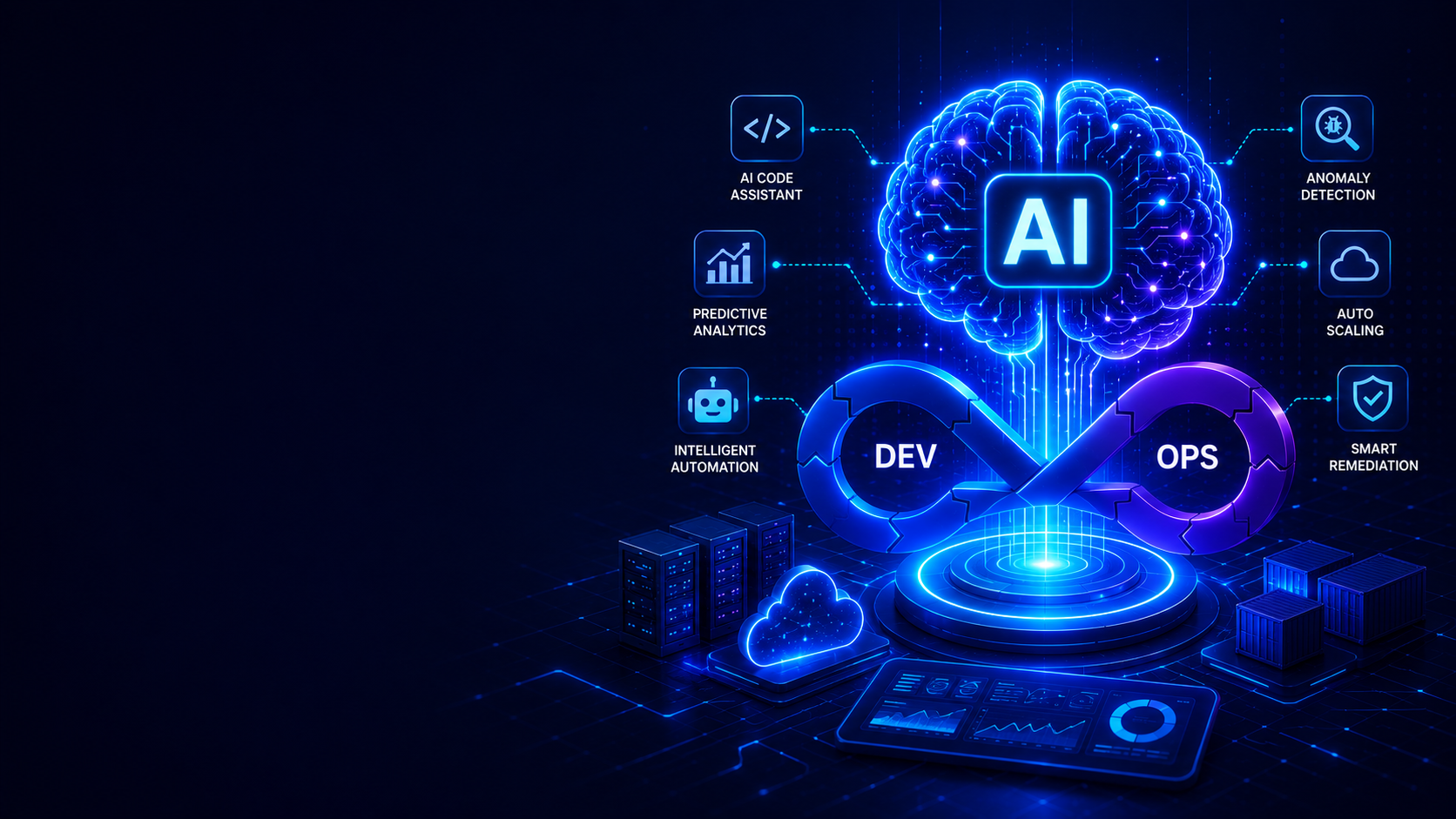
DevOps transformed how we build and ship software. Now a similar transformation is happening for machine learning and artificial intelligence systems, and it is called MLOps. For engineers who already understand cloud and DevOps, this is one of the most exciting and highest-paid frontiers in the field — and importantly, it builds on the skills you already have rather than replacing them. This guide explains what MLOps really is, how it differs from DevOps, and why AI-Native DevOps engineers are in such demand.
What Is MLOps?
MLOps applies DevOps principles — automation, versioning, testing, monitoring, and continuous delivery — to machine learning systems. But machine learning introduces challenges that traditional DevOps never had to handle. You are not just deploying code; you are deploying code, data, and a trained model together, and all three change over time and must be reproducible. MLOps is the discipline of managing that added complexity in a reliable, automated way.
Why Machine Learning Systems Are Different
- Data is a first-class citizen. The same code trained on different data produces a different model, so data must be versioned just like code, and you must be able to reproduce exactly which data produced a given model.
- Models drift. A model that was accurate last month can degrade as the real world changes around it, so you must monitor prediction quality and accuracy, not just uptime and latency.
- Training is expensive. Training often needs costly GPU resources, so pipelines must manage those resources efficiently and avoid waste.
- Reproducibility is hard. You need to recreate exactly which data, code, parameters, and environment produced a specific model, which requires careful tracking at every stage.
The MLOps Lifecycle
A mature MLOps workflow covers the whole journey end to end. It starts with collecting and versioning data, then training and evaluating models while tracking every experiment so results are reproducible. The winning model is packaged, deployed as a service, and served to applications. Once in production, its accuracy is monitored continuously, and when the model drifts beyond an acceptable threshold, the pipeline retrains it on fresh data and redeploys — closing the loop. It is DevOps thinking applied to the full machine-learning lifecycle.
The Rise of AI-Native DevOps
Beyond serving traditional machine-learning models, a newer discipline has emerged around large language models and generative AI. AI-Native DevOps engineers deploy and operate systems built on these models — retrieval-augmented generation pipelines that combine a model with a company's own data, vector databases that store and search embeddings, prompt orchestration, and scalable inference services. They also use AI to improve operations itself: intelligent alerting, anomaly detection, and automated incident remediation, an area often called AIOps. This blends classic reliability engineering with the new world of AI systems.
The Tools You Will Encounter
The ecosystem includes experiment tracking and model registries for reproducibility, pipeline orchestration for training workflows, model-serving frameworks for deploying models as scalable services, vector databases for AI retrieval, and the managed AI platforms offered by the major clouds. You do not need to master all of them at once. Understand the lifecycle first, then learn one representative tool per stage — data versioning, experiment tracking, serving, monitoring — and you will be able to reason about any specific stack.
How to Get Into MLOps
The good news is that MLOps builds directly on cloud and DevOps fundamentals. If you already know Docker, Kubernetes, CI/CD, and a cloud platform, you are most of the way there. Add a working understanding of the machine-learning lifecycle, learn to containerise and serve a model behind an API, build a pipeline that trains and deploys it automatically, and add monitoring for prediction quality. You do not need to become a research scientist — you need to operationalise models reliably, which is an engineering skill.
Why This Is a Smart Career Bet
Demand for engineers who understand both cloud operations and machine learning far outstrips supply. In India, MLOps and AI-Native DevOps roles command some of the highest salaries in the field, often ranging from twelve to thirty lakh per annum and beyond, because they combine two scarce skill sets. Crucially, these roles level up your existing DevOps and cloud knowledge rather than asking you to start over. As more companies move AI from experiments into production, the need for people who can run these systems reliably will only grow.
Common Mistakes
- Trying to learn MLOps before having solid DevOps and cloud fundamentals.
- Focusing only on model accuracy and ignoring the operational lifecycle around it.
- Neglecting data and model versioning, making results impossible to reproduce.
- Deploying a model once and never monitoring for drift.
Frequently Asked Questions
Do I need to be a data scientist to do MLOps? No. MLOps is an engineering role focused on operationalising models. A working understanding of the ML lifecycle is enough; deep research skills are not required.
Is AI-Native DevOps just hype? The tools will keep evolving, but the underlying need — running AI systems reliably in production — is real and growing fast, and it rewards strong engineering fundamentals.
What should I learn first? Solidify DevOps and cloud, then learn to containerise, serve, and monitor a model. Build one end-to-end project.
Our flagship AI-Native DevOps track at Infinity Cloud Labs takes you from core cloud and DevOps skills through MLOps and generative-AI operations, all on real infrastructure — in both English and Telugu.
Tags