
Site Reliability Engineering — SLIs, SLOs & Error Budgets Explained
SRE turns reliability into an engineering discipline with real numbers. Understand service level indicators, objectives, and error budgets — the core ideas behind the role.
Rajesh Vardhan Busam
SRE & Observability Instructor
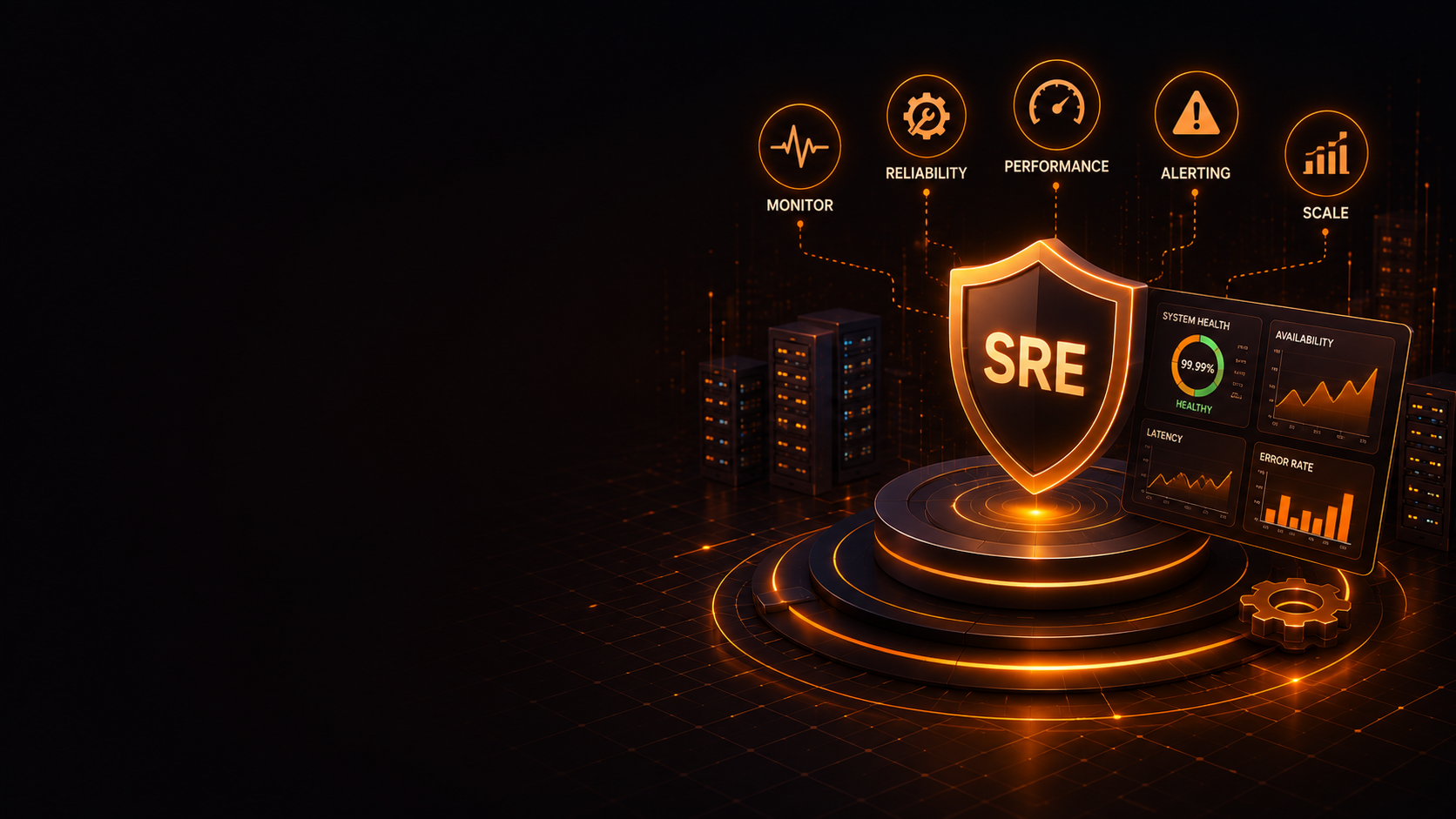
Site Reliability Engineering, or SRE, is a discipline that treats operations as a software problem, and it is one of the best-paid roles in the industry. At its heart is a simple, powerful set of ideas for measuring and managing reliability with real numbers instead of vague feelings. Once you understand service level indicators, objectives, and error budgets, the whole approach to running reliable systems clicks into place. This guide unpacks the core concepts and the culture that surrounds them.
SRE vs DevOps
DevOps is a culture and a set of practices for building and shipping software collaboratively, breaking down the wall between development and operations. SRE is a specific, prescriptive implementation of those ideas, originally created at Google, with a strong focus on reliability, measurement, and automation. A useful way to hold the distinction: DevOps says what the goal is, and SRE says how to achieve it with concrete engineering practices and metrics. In many companies the roles overlap, but SRE brings a sharper focus on reliability as a measurable, managed quantity.
Service Level Indicators
A service level indicator, or SLI, is a direct, quantitative measure of some aspect of your service that users genuinely care about. Common indicators include availability — the proportion of requests that succeed — latency — how many requests are served faster than a threshold — and error rate. The essential point is that a good SLI measures the user's actual experience, not an internal detail like CPU usage. A server can be busy and still serving users perfectly; what matters is whether requests succeed quickly.
Service Level Objectives
A service level objective, or SLO, is a target for an SLI over a window of time. For example: ninety-nine point nine percent of requests should succeed over a rolling thirty-day period. The SLO is a clear, agreed promise about reliability that the whole team commits to. Crucially, a good SLO is deliberately not one hundred percent, because chasing perfect reliability is astronomically expensive and almost always unnecessary — users rarely notice the difference between very reliable and perfectly reliable, but the cost difference is enormous.
The Error Budget — The Clever Part
If your SLO is ninety-nine point nine percent success, then the remaining zero point one percent is your error budget — the amount of unreliability you are allowed to spend over the period. This single reframing turns reliability into a resource to be managed, and it resolves the age-old tension between developers who want to ship features fast and operators who want stability.
Here is how it works in practice. When there is error budget remaining, the team can take risks and ship new features quickly, because there is room for the occasional problem. When the budget is exhausted because reliability has slipped, the team pauses risky feature work and focuses on stability until the budget recovers. This is an objective, data-driven way to balance speed and safety — decisions are made from a shared number, not from gut feeling or the loudest voice in the room.
Toil and Automation
SRE gives a name to repetitive, manual, reactive operational work: toil. Restarting the same service by hand, manually applying the same fix, copying data around — these are toil. The SRE philosophy is to cap the amount of time spent on toil and to relentlessly automate it away, so engineers spend their time on lasting improvements rather than firefighting the same issue repeatedly. Reducing toil is both a productivity win and a job-satisfaction win, because nobody enjoys doing the same tedious task for the hundredth time.
Blameless Postmortems
When something breaks — and in any real system, it eventually will — SRE culture runs a blameless postmortem. This is a written analysis focused on what in the system allowed the failure, not on who to blame for it. The goal is to understand the contributing causes and make the same failure impossible or less harmful next time. The blameless framing is essential, because psychological safety is what lets people be honest about what happened. When engineers fear blame, they hide mistakes, and the organisation stops learning.
Monitoring That Supports SRE
All of this depends on good measurement. You need monitoring that captures your SLIs accurately, dashboards that show your current position against your SLOs, and alerting that pages a human when the error budget is burning too fast. This is where tools like Prometheus and Grafana come in — they are the instruments that make reliability visible and manageable. Without solid observability, SLOs and error budgets are just words.
Common Mistakes
- Setting an SLO of one hundred percent, which is unachievable and financially ruinous to pursue.
- Choosing SLIs that measure internal metrics instead of the user's real experience.
- Defining SLOs and then ignoring them when they are breached.
- Running postmortems that assign blame, which teaches people to hide problems.
- Accepting endless toil instead of investing in automation.
Frequently Asked Questions
Do I need to be at a huge company to practise SRE? No. The ideas — measure what users experience, set honest targets, use error budgets to make decisions, reduce toil, learn blamelessly — apply at any scale.
What is the difference between an SLA and an SLO? An SLO is your internal target; a service level agreement, or SLA, is a formal contract with customers, usually set looser than the SLO so you have a safety margin.
Is SRE a good career? Yes — it combines deep systems knowledge, coding, and a measured, scientific approach to operations, and companies pay a premium because reliable systems directly protect revenue and reputation.
If you enjoy both building systems and understanding how they fail, SRE is a superb path. Our SRE track at Infinity Cloud Labs teaches SLIs, SLOs, error budgets, monitoring, and incident response on real systems — in both English and Telugu.
Tags